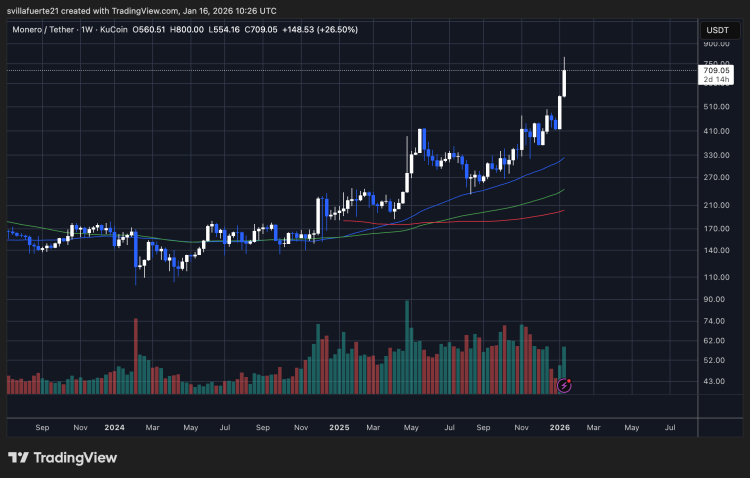
Monero (XMR), one of crypto’s most established privacy-focused assets, has exploded higher to start 2026, delivering one of the strongest moves in the market over the past few days. Monero is built around private, censorship-resistant transactions, using cryptography to obscure wallet balances and transfer details on-chain. That privacy-first design has kept XMR in its own category for years, often moving independently from large-cap altcoins when narrative-driven momentum returns.
Related Reading
Since the beginning of the year, XMR has surged from roughly $410 to nearly $799, a near-vertical move that reflects both aggressive demand and a rapid shift in trader attention toward the privacy coin sector. The breakout comes after similar sharp rallies in names like Zcash (ZEC) and Dash (DASH), which also experienced explosive upside followed by fast pullbacks.
Zcash climbed to around $750 before reversing toward the $400 zone, while Dash ran to roughly $120 and later dropped to near $35. Those moves set the tone for a volatile privacy coin rotation, where price action tends to accelerate quickly once momentum enters the sector.
Now, with Monero leading the pack, the market is watching whether this rally can establish higher support levels, or if it becomes another short-lived spike driven by crowded positioning and thin liquidity.
Retail Hype Signal Flashes As Monero Extends Its Breakout
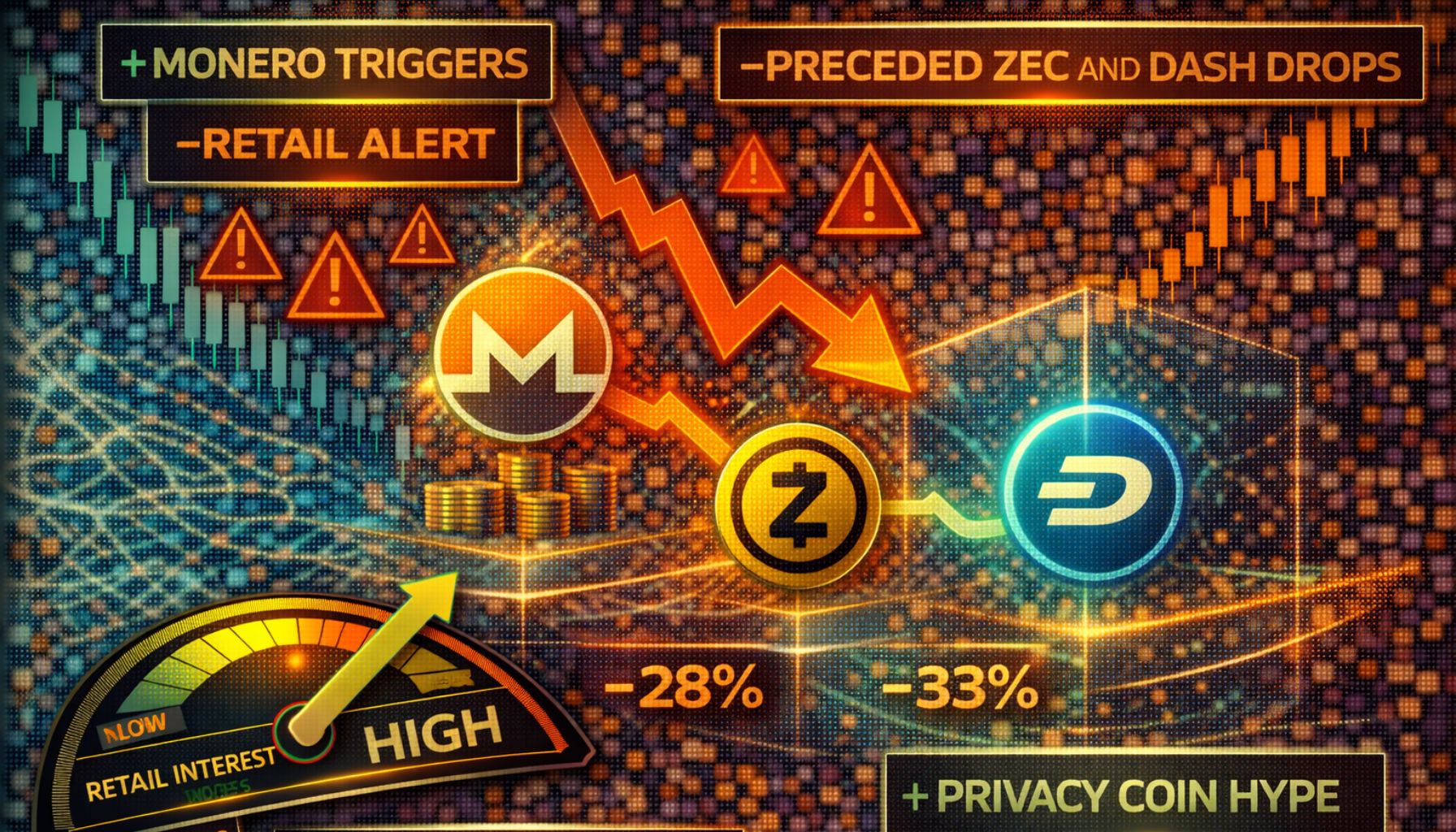
Monero’s surge is now starting to show the same “retail frenzy” footprint that appeared earlier in other privacy coins, raising questions about how sustainable this move really is. A trading frequency signal—often associated with crowded participation and late-stage chasing—previously lit up in Zcash and Dash near their local tops, before both coins reversed sharply.

In Zcash, the retail-heavy activity spike aligned with a push to roughly $698, and the price has since slid back to around $442, a drawdown of about 37%. Dash followed a similar pattern. The trigger appeared near $120, before the market cooled off aggressively and dragged the price down to the $57 zone. A decline of roughly 52%.
Now, the same signal is flashing for Monero. The retail-frequency threshold appeared around $714 as XMR traded deep into its parabolic advance. That matters because these setups often reflect emotional participation, where buyers enter late, liquidity thins, and volatility increases sharply.
This doesn’t guarantee an immediate top, but history suggests a clear risk: once retail demand becomes dominant, the rally can become fragile. The bigger question is whether Monero can absorb profit-taking without breaking structure—or if it repeats the same post-spike unwind seen in ZEC and DASH.