



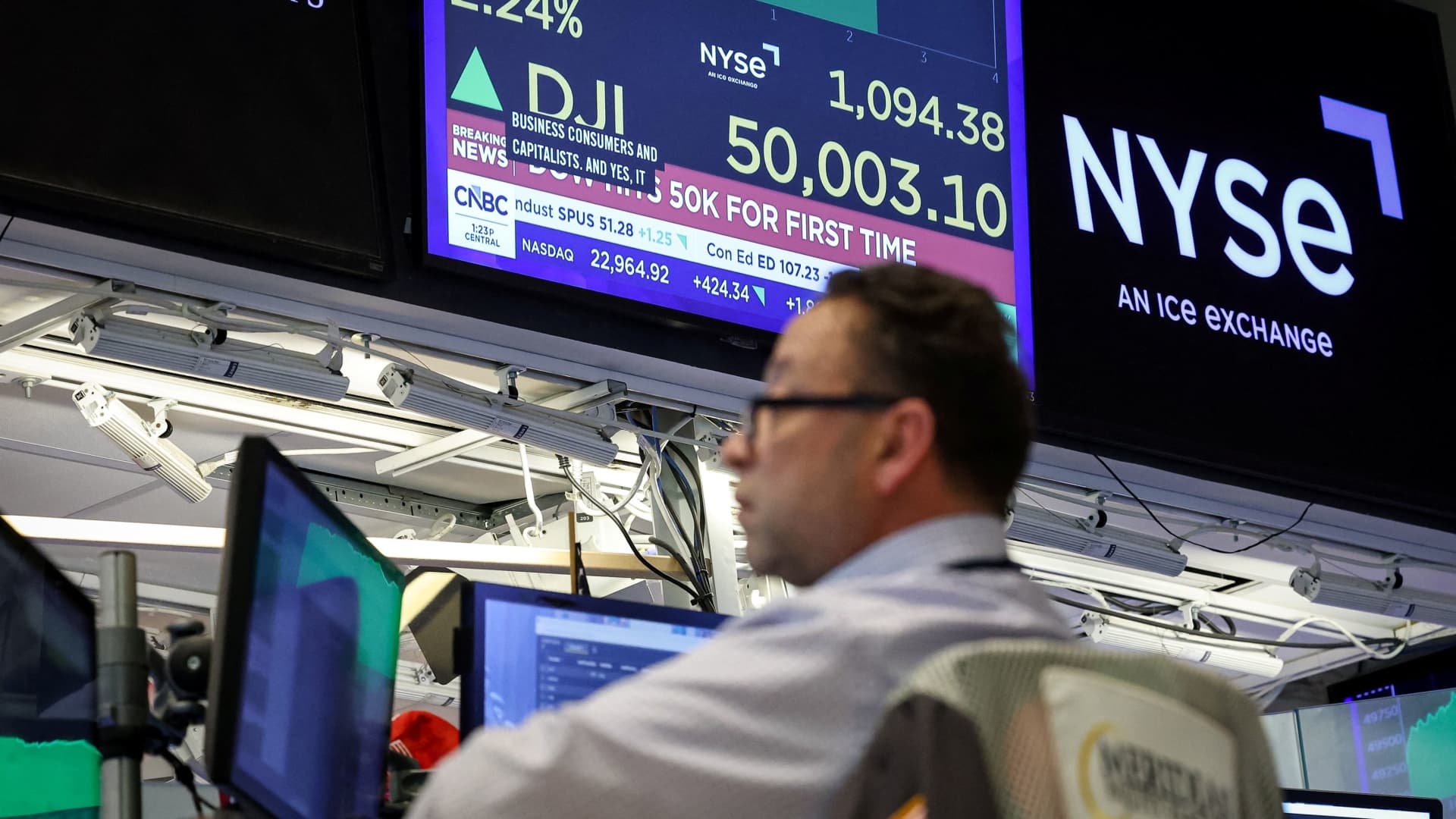
A trader works as the Dow Jones Industrial Average surpasses the 50,000 mark on the floor at the New York Stock Exchange (NYSE) in New York City, U.S., Feb. 6, 2026.
Brendan McDermid | Reuters
There’s a disconnect between the stock market and consumer optimism — and some economists say affordability is a primary culprit.
Over the last four to five years, the stock market has become divorced from consumer sentiment: Stock valuations have soared while consumer optimism has plunged to near-record lows, economists said.
The dynamic is atypical, said Joe Seydl, a senior markets economist at J.P. Morgan Private Bank.
Prior to 2022, stock markets and consumer sentiment largely moved in sync, shifting up and down based on prevailing economic conditions, Seydl said, based on an analysis of data dating to the early 1990s. When times were good, both moved upwards in tandem, and vice versa.
“It really breaks the 25-year relationship between the two series,” Seydl said.
A separate analysis by Oxford Economics found a similar dynamic.
The University of Michigan’s consumer sentiment index should have ended 2025 at a value of 93, based on indicators like stock prices, unemployment and inflation, according to that Oxford Economics study, published Jan. 27. Instead, it was 40 points lower, near an all-time low.
“Historically, household perceptions of the economy closely tracked key macroeconomic indicators,” according to Oxford Economics. “Today, those indicators suggest consumers should be feeling significantly more upbeat than they do.”
Impacts of the ‘vibecession’
Measuring how consumers feel — and how that sentiment relates to the stock market and broad economy — is important since consumer spending accounts for the bulk of U.S. economic output, said John Canavan, lead analyst at Oxford Economics.
The so-called “vibecession” — or the sour mood — among consumers is likely due to their views on affordability, Seydl said.
“Affordability is sort of this catch-all term for widespread dissatisfaction by consumers of current economic outcomes,” Seydl said.

The dynamic could have repercussions for the overall economy, the outcome of upcoming midterms in November and policies pursued by lawmakers ahead of those elections, analysts said.
“Affordability was important in the 2024 election,” Seydl said. “The thing that helped [Republicans] do so well [in that election] is now a potential vulnerability as we head into the 2026 midterm elections.”
“The [Trump] administration is hyper-focused on this,” he said.
Why affordability is a concern
There are many factors driving the eroded sense of economic well-being, economists said.
Among them are higher prices, housing affordability and a cooldown in the job market.
Overall prices are ‘sharply higher’
While inflation has throttled back, the overall price level for U.S. goods and services is much higher than it was before the Covid-19 pandemic, Seydl said.
Average consumer prices increased by about 26% from December 2019 to December 2025, according to data from the Bureau of Labor Statistics.
“Prices are sharply higher than they were five years ago,” Canavan said. “It’s still very uncomfortable for most consumers to look at prices today, even if inflation — or the rate of price growth — has slowed considerably.”
Homeownership costs
Homeownership costs have also soared, Seydl said.
Average rates for a 30-year fixed-rate mortgage were just over 6% as of Feb. 5.
While they’ve declined from a high of about 8% in 2023, they’re still considerably higher than before the Covid-19 pandemic; indeed, you’d have to go back to around the time of the 2008 financial crisis, when the housing bubble burst, to see rates north of 6%.
The typical family spends about 38% of their income on housing to cover the mortgage on the typical new home, according to a February 2025 analysis by the National Association of Realtors.
Meanwhile, the U.S. Department of Housing and Urban Development considers a home to be “affordable” if monthly payments don’t exceed roughly a third of the household’s gross income.
A frozen labor market
Additionally, many consumers feel shut out of the current “low-hire, low-fire” labor market, Seydl said.
Hiring has stalled out at one of its lowest levels in more than a decade. Layoffs are also at historically low levels, according to federal data dating back to the early 2000s, creating few open roles for job seekers and new entrants to the labor market.
Jobholders may also feel less flexibility in the workplace, Seydl said. Employers have gradually called employees back to in-person work and stripped away pandemic-era hybrid and remote work opportunities, fueling the sense of a worse work-life balance, he said.
Artificial intelligence and technology
So, what’s been propping up the stock market and economy amid such a sour mood?
Artificial intelligence and technology are a big reason, economists said.
The stock market has been propelled higher in large part due to the stocks of a handful of mega-cap technology companies — the so-called Magnificent Seven, Canavan said. These companies include Apple, Amazon, Alphabet, Meta, Microsoft, Nvidia and Tesla.
With some exceptions like Amazon, these companies don’t rely heavily on consumer spending, meaning consumer sentiment and spending haven’t driven their surging share prices, he said.
Companies have also spent heavily to build data centers that underpin their AI growth, Seydl said.
That investment has helped propel U.S. economic growth in recent years but won’t create many jobs — or lift incomes, by extension — relative to more labor-intensive sectors like leisure and hospitality, education and health care, for example, he said.
K-shaped economy
High-income households have been propping up the stock market and broader economy, economists said.
For example, consumers in the top 10% of the income distribution accounted for more than 49% of consumer spending in the second quarter of 2025, the highest level since data started being compiled in 1989, according to Mark Zandi at Moody’s Analytics.
The Federal Reserve Bank of Dallas found a similar trend: Consumer spending among the top 20% of households by income is up 4 percentage points over the last three decades, to 57%, it found.
The emergence of this so-called “K-shaped” growth — whereby spending increases for those at the top but falls for those at the bottom — may pose economic risks, according to the Dallas Fed analysis.
That’s because maintaining spending levels among the wealthy likely depends on the stock market remaining strong, Canavan said.
Stocks are disproportionately owned by high-income and wealthy households. Their spending is guided by a so-called wealth effect, whereby they spend more freely because their sizable stock earnings in recent years lead them to feel rich, Canavan said.
However, there’s a question as to how long that can last, he said.
“It partly depends on how long the equity gains can continue,” Canavan said.
