



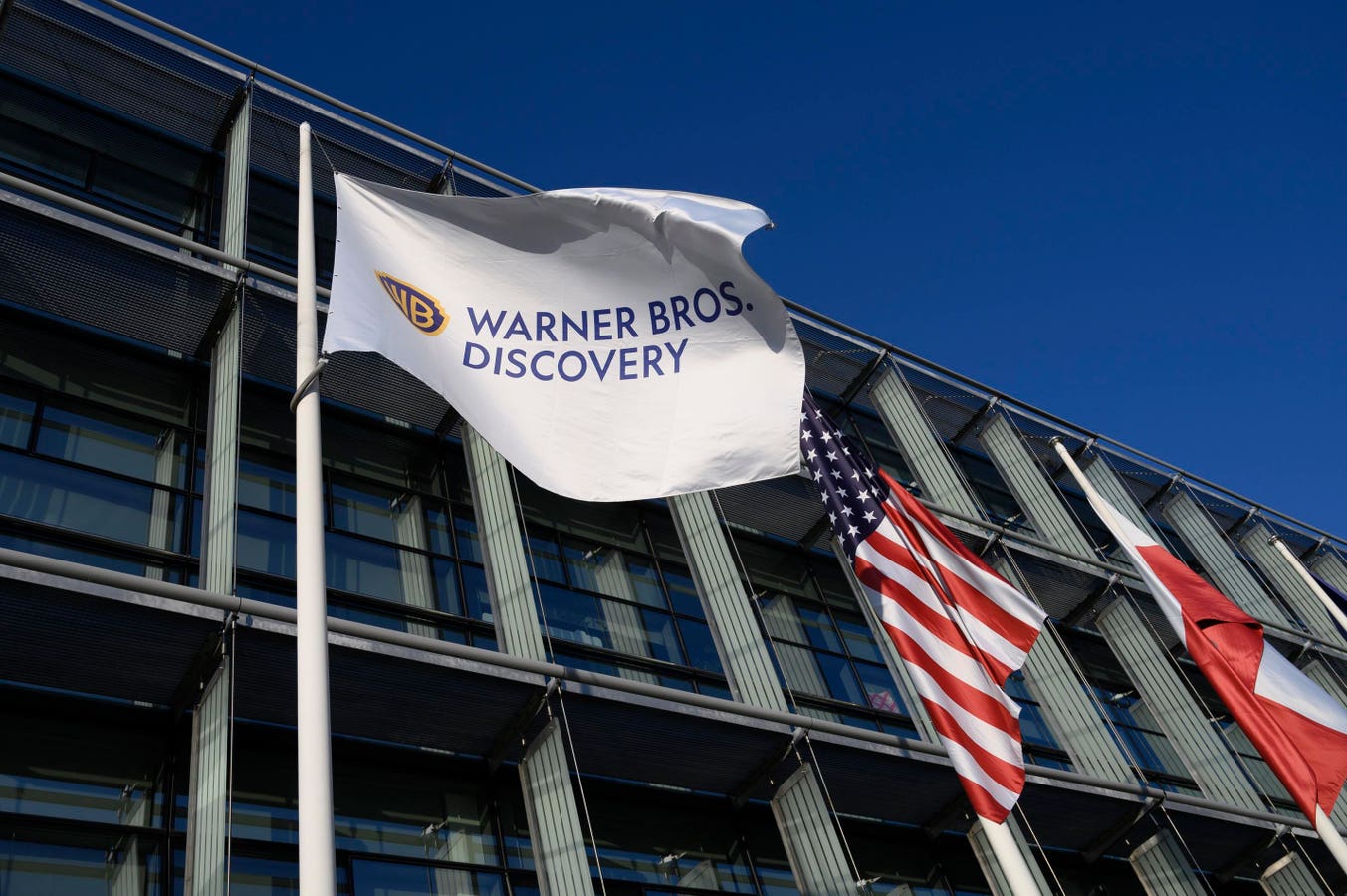
A Warner Bros (Discovery) flag is fluttering outside the TVN broadcaster headquarters in Warsaw, Poland, on August 6, 2024. Warner Bros Discovery is looking to offload smaller assets in a bid to avoid a breakup of the company. (Photo by Aleksander Kalka/NurPhoto via Getty Images)
NurPhoto via Getty Images
Warner Brothers Discovery stock is up 91% so far this year.
The company’s stock could rise another 50% – to a market capitalization of $75 billion, Bank of America analyst Jessica Reif Ehrlich suggested to the New York Times.
After turning down a second takeover offer from Paramount on Tuesday, Warner Brothers Discovery has put itself in play, noted the Wall Street Journal.
Whether the stock rises more could depend on the financial wherewithal of potential acquirers and the knotty antitrust issues facing potential bidders – such as Paramount, Comcast and Netflix.
Below is a ranking of the potential bids based on ability to pay and antitrust risk:
Netflix (50% to 60% approval likely, with conditions).
While Netflix likely cannot afford the full price – so it might not buy all WBD’s assets. Due to Netflix’s lack of traditional media overlap, a Federal Communications Commission review would not be needed. The combined streaming market share of 35% to 40% may raise concerns which could be mitigated by behavioral remedies such as content licensing requirements for seven to 10 years.
Paramount (30% to 40% chance of approval).
Since Paramount’s market capitalization of $16 billion is way below WBD’s, the bid would require funding – possibly from private equity and debt. Meanwhile this bid would face high antitrust risk due to potential market concentration in streaming and film production. With combined market share too high (theatrical 34.5% and cable 35% to 40%) and consolidation of news – CBS News and CNN – under Ellison family control, the deal would likely require divestitures exceeding $15 billion to $20 billion.
Comcast (less than 10% chance of approval).
While Comcast could raise the capital, antitrust risk would be very high due to vertical integration – the deal would combine top studios and distribution. The Department Of Justice previously blocked the Comcast-Time Warner Cable merger specifically to prevent such an “unavoidable gatekeeper” scenario. By adding content to the nation’s largest broadband provider, that concern would increase were Comcast to bid for WBD. The required divestitures of cable systems or entire studios exceeding $50 billion would destroy the deal’s strategic logic.
Despite these challenges, the company is likely going to be sold. One big reason is the incentive for Warner CEO David Zaslav to do a deal. “This summer, after consulting with his longtime mentor, the media magnate John Malone, Mr. Zaslav signed a new contract that pays him millions of dollars if the company changes hands,” reported the Times.
Read on for the antitrust challenges these companies bids may encounter and how they might be resolved.
What Is Warner Brothers Discovery?
WBD is a leader in streaming, film production, premium content, and cable. The company controls 116.9 million streaming subscribers through Max and Discovery+, major film studios including Warner Bros. and DC, premium content libraries (Harry Potter, Game of Thrones), and cable networks reaching 1.1 billion global viewers, according to Sports Video Group.
WBD’s business challenges make a sale increasingly attractive. That’s due to the company’s $34.6 billion in debt, loss of NBA rights costing $600 million annually, noted Fast Company, and an accelerating decline in linear TV decline. The critical question is whether regulators will permit further consolidation in an already concentrated media industry.
Warner Discovery already has rejected two offers from Paramount. The company said Tuesday it would review strategic alternatives after receiving “inquiries for all or some of the company,” added the Journal.
WBD would prefer to split itself in two public companies. Zaslav would lead the TV and movie studios and HBO Max while CFO Gunnar Wiedenfels would run the company’s cable networks, including CNN and TNT, the Journal wrote.
Potential Netflix Bid For $WBD
Netflix presents the most interesting scenario because it would face less antitrust scrutiny than Comcast or Paramount due to the absence of traditional media overlaps, yet still confronts significant obstacles from streaming market concentration.
However, Netflix does not see itself as an acquirer. The company indicated skepticism about “big media mergers,” Co-CEO Greg Peters recently stated according to Variety. “We come from a deep heritage of being builders rather than buyers,” he added.
If Netflix merged with WBD, the combined streaming market share – 37% – Netflix’s 21% to 22%, noted Variety, and WBD’s 10% to 15%, as The Hollywood Reporter wrote – would likely trigger monopoly-level concentration. The 37% share would top the 30% threshold that triggers presumption of illegality, according to White & Case.
Regulators’ primary concern for this deal would be Netflix’s power to withhold content from rivals – thus foreclosing competition. Netflix would have both the ability and incentive to withhold must-have content – HBO/Max premium content from Disney+, Amazon Prime Video, Paramount+, and Peacock, noted Variety.
A so-called behavioral remedy could overcome this antitrust problem. This might take the form of a seven to 10 year agreement requiring Netflix to license key WBD content – such as HBO originals, Warner Bros. films, DC content, and Discovery programming — to competitor streaming platforms on reasonable terms. This would be similar to what the DOJ required for the completion of the Comcast-NBCU deal.
Potential Paramount Bid For $WBD
The potential Paramount deal to acquire Warner has been rejected twice already and is likely to be blocked or abandoned. There is an estimated 60% probability the antitrust math and news concentration concerns mentioned above will block the deal.
With 28% of domestic box office, the combination of Warner with Paramount’s 6.5% would top the 30% threshold mentioned above – triggering illegality.
Moreover, the combined companies – consisting of CNN, TNT, TBS, HGTV, Food Network, and Discovery networks alongside CBS, MTV, Nickelodeon, Comedy Central, BET, and Showtime – would control 35% to 40% of the linear TV market. This is “likely among the biggest sources of potential regulatory push back,” MoffettNathanson analysts said, according to Variety.
Finally, the combined companies would control 15.4% of the streaming market between Paramount+’s 8.7% share and Max/Discovery+’s 6.7%, noted Statista.
With large divestitures – disposing of either CNN or CBS News, substantial cable network portfolio sales, and streaming platform separation – the deal would have a 30% chance of being approved.
Finally, there is perhaps a 10% chance political, rather than antitrust considerations will prevail – leading to approval with light conditions.
Potential Comcast Bid For $WBD
Since regulators blocked the Comcast-TWC merger on vertical integration grounds in 2015, the same logic would likely block a Comcast-Warner Discover deal.
The key antitrust problem is Comcast’s position as an unavoidable gatekeeper to 32 million subscribers representing more than 40% of the U.S. broadband market in 40 states, according to the DOJ.
Moreover, the deal would result in 36% combined market share in movie theaters, accumulation of more must-have sports rights – such as Sunday Night Football (NBC) and March Madness (WBD), and news market dominance – consolidating NBC News, MSNBC, CNBC, CNN, and HLN – would echo the Comcast-TWC antitrust argument.
More specifically, a Comcast-WBD merger would likely be quashed because it features “potential competitive problems not overcome by significant merger-specific cost savings or consumer benefits,” noted the Antitrust Institute.
What Analysts Are Saying
Analysts see other potential bidders – throwing Amazon and Apple into the mix, reported the Journal.
They are divided on whether a Paramount bid is likely. “We struggle to see a credible stand-alone future for Paramount as the kind of company it aspires to be,” Bernstein analyst Laurent Yoon told the Journal, who said WBD owns “the assets everyone wants.”
Another analyst expects Paramount to win the bidding. “We continue to think that a transaction with Paramount is reasonably likely,” TD Cowen analyst Doug Creutz wrote in a note to clients Tuesday, according to Variety.
“Ultimately, we believe Paramount remains the most likely to succeed in acquiring WBD,” agreed MoffettNathanson analysts Robert Fishman and Craig Moffett.
Comcast would face longer odds. “Given past commentary against all-things-Comcast from both the White House and the FCC over the past year,” Moffett noted, “a successful Comcast acquisition of almost anything seems nearly unthinkable,” Variety reported.
With a rocky ride ahead, risk-loving investors may profit from buying $WBD.
