



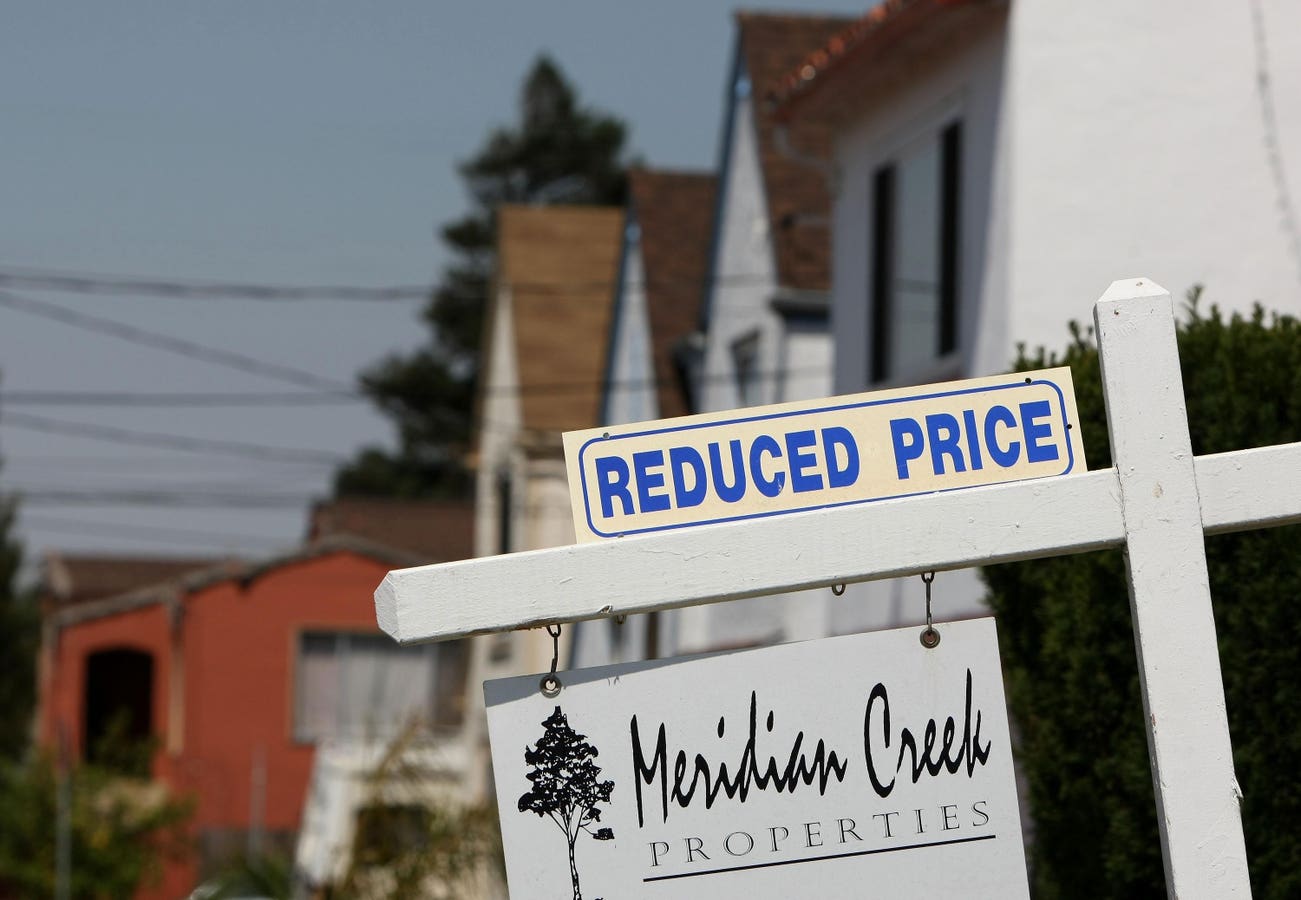

Trump’s 50-Year mortgage plan aims to make homeownership more affordable through longer loan terms.
Getty Images
President Donald Trump’s recent embrace of a 50-year mortgage has injected an unusual idea into the debate over housing affordability. If you can’t make house prices lower quickly, perhaps you can stretch out the time associated with paying them.
On social media and in remarks amplified by his housing team, Trump has floated the notion of government-backed mortgages with terms up to 50 years as a way to help home buyers locked out of the housing market by high prices and elevated interest rates. A Federal Housing Finance Agency official confirmed that expanding the term of government-backed mortgages is at least under serious consideration.
Critics immediately seized on the idea as a gimmick that papers over deeper problems in the housing market. But looked at through a broader lens, especially one focused on national saving and investment policy, the proposal deserves more serious consideration than it’s getting.
The Government’s Longer Time Horizon
One useful way to think about the mortgage question is to ask, what is government uniquely positioned to do that the private sector won’t?
Private financial institutions operate under relatively short time horizons, with business management often focused on quarterly earnings. Even a 30-year mortgage is usually packaged into securities and turned over on bank balance sheets much faster than the mortgage gets paid off. When repayment stretches out over half a century, interest-rate and credit risks become harder to manage, and purely private markets will often under-supply that kind of credit, or else they will charge a steep premium for it.
Government, by contrast, is a perpetual entity. It does not have a natural “end date” in the way that a firm that goes bankrupt or an individual who passes away does. That makes it better suited to facilitate some very long-duration contracts and investments, especially in areas like infrastructure or innovation policy, where benefits can take decades to accrue.
There are several places where this longer time horizon can create genuine value. First, government can sometimes bear long-term risks that are simply too big or too uncertain for private actors to manage efficiently. Governments can spread those risks broadly across taxpayers and generations too, occasionally at a lower overall cost to society.
Second, individuals and firms tend to heavily discount the distant future. Politicians can be short-sighted too, no doubt. But the political system is also capable of giving weight to the interests of future people that are not yet at the bargaining table. For example, when Congress funds basic scientific research, it is effectively prioritizing benefits that will accrue decades from now over benefits to the current citizenry. In doing so, the political system counters some of the short-run pressures inherent in financial markets, nudging the economy in the direction of taking a longer-run perspective.
Third, by organizing a broad pool of public savings, governments can expand the supply of long-term capital available for investment, putting downward pressure on interest rates. A 50-year mortgage fits neatly into this framework. It relies on the federal government’s unique ability to transform public savings into longer-duration loans than private markets would be willing to offer.
How a 50-Year Mortgage Could Help
The most obvious effect of a 50-year mortgage is that by stretching out repayment, it lowers monthly payments relative to a 30-year loan on the same principal. Analyses of proposals like Trump’s illustrate that payments on a median-priced home could fall by a couple of hundred dollars per month with a 50-year term, though total interest over the life of the loan also rises by thousands of dollars.
The deeper economic effect is on the supply of long-term mortgage credit. In many hot housing markets today, the relevant interest rate on marginal borrowing is not 6 or 7 percent, it is effectively infinite in the sense that many potential buyers simply cannot access financing at any rate. From that perspective, expanding the available term structure of loans can move the price of credit from “no deal at any rate” to some positive rate that clears the market.
That matters for several reasons. Credit access improves for households as buyers gain a new margin of flexibility. The broader macroeconomy also benefits, because extending terms is one of the levers available to pad the economy with more savings, thereby lowering rates in real terms. At the level of national economic strategy, channeling more long-term savings into mortgage credit is also one way of consciously shaping the country’s portfolio of investments.
On all of these fronts, Trump’s instinct that longer-term mortgages would be “no big deal” from a financial-engineering perspective is basically right. The United States is already comfortable with 30-year fixed-rate mortgages, a product that is virtually unknown in many other countries. Pushing this frontier to 50 years represents a further innovative evolution.
Learning from Switzerland: Interest-Only and “Never Repaid” Mortgages
One common criticism of the 50-year mortgage idea is that borrowers will be in debt for life. That concern is not obviously a problem, however.
Consider Switzerland. There, it is a common practice for homeowners never to pay off their mortgages completely. Banks often finance a large share of a property’s value as a first mortgage that does not have to be fully amortized, so long as affordability tests are met and a certain loan-to-value threshold is respected. Only that borrowed portion above the threshold must be paid down as a second mortgage paid out over a period such as 15 years. The remainder can effectively be rolled over indefinitely, with borrowers paying interest and perhaps modest principal but never aiming to extinguish the debt entirely.
The result is a system where many households carry interest-only or minimally amortizing mortgages indefinitely and families free up cash to invest in businesses, retirement accounts, and other productive assets. Switzerland, notably, has one of the world’s highest standards of living and a reputation for financial stability. Its unusual mortgage practices have not produced a systemic disaster. Instead, they reflect an explicit policy choice to treat housing as a long-term leveraged asset rather than something that must be owned free and clear by retirement.
A U.S. 50-year mortgage would not replicate the Swiss model exactly, but it moves in that direction by recognizing that lifetime housing debt is not inherently pathological.
The Critics’ Case
Critics of Trump’s proposal emphasize several downsides. They are correct that stretching a loan from 30 to 50 years increases the amount of interest paid in total, even if the borrowing rate is identical. That is simple arithmetic. They also worry that borrowers will build home equity more slowly, which can leave them more vulnerable to market downturns or life events that force them to sell. In addition, there are legal and regulatory hurdles. Under existing rules, mortgages longer than 30 years cannot qualify as “qualified mortgages,” so a 50-year product would require statutory or regulatory changes.
These are real concerns. But they are not the most important critique.
The more fundamental objection is that the U.S. housing market’s core problem is supply, not demand. Zoning restrictions, permitting delays, environmental reviews, and local opposition have all conspired to make it extraordinarily difficult to build new housing in the parts of the country where people most want to live. Simply stretching mortgages to 50 years, or otherwise boosting demand, won’t necessarily add many homes to the nation’s housing stock.
If anything, enhanced purchasing power could bid up prices further in constrained markets, redistributing wealth to existing homeowners and landowners rather than increasing affordability for newcomers. Many economists, including some who might otherwise be sympathetic to innovation in mortgage design, therefore view the 50-year idea as a distraction from the more urgent task of unlocking supply.
There’s also a broader capital-allocation question. Should our national saving policy continue to favor housing so heavily? Every dollar of subsidized mortgage credit is a dollar that might have gone into other forms of investment, such as research and development, business equipment, or infrastructure, which could all potentially yield higher long-run growth and improvements in living standards. It is not obvious that subsidizing housing demand should be the top priority at a time when other investments may do more to raise productivity.
Still Worth Trying As One Experiment Among Many
Even granting these critiques, there is a strong case for treating 50-year mortgages as an experiment worth running.
First, the proposal expands choice. Some households will rationally prefer a lower monthly payment and slower equity accumulation, especially if they anticipate moving or refinancing before the full 50 years anyway. Others can stick with 15- or 30-year loans. The existence of a new option doesn’t force anyone into it.
Second, a government-facilitated 50-year product could generate revenue. If Fannie Mae and Freddie Mac can prudently price and securitize these loans, the federal government can capture some of the term premium that markets are currently unwilling to earn on their own. In effect, Washington would be monetizing its own ability to take a longer-run perspective than private investors.
Third, policy innovation in the mortgage space has been conspicuously lacking. The U.S. mortgage system still bears the imprint of decisions made in the 1930s. In a dynamic economy, we should expect the menu of loan products to evolve. Portable mortgages, assumable mortgages, and, yes, longer-duration mortgages are all ideas being floated today, and they deserve pilot programs and rigorous evaluation rather than instant dismissal. Ideally, a 50-year mortgage initiative would be paired with aggressive supply-side reforms to land-use regulation, a broader rethinking of how heavily we want to tilt the national balance sheet toward housing, and clear, simple disclosures so borrowers understand the tradeoffs between monthly affordability and lifetime interest costs.
Toward a More Deliberate National Savings Strategy
Seen in isolation, Trump’s 50-year mortgage idea is an imperfect tool aimed at a real problem. It will do too little to expand the domestic housing supply and could further entrench housing’s privileged status in our saving and tax system.
But seen as a step toward a more intentional national savings strategy, it has real merit. It leverages government’s unique ability to stretch time horizons, broadens the menu of contracts available to households, and may even open a modest new revenue stream for the public sector.
The key is not to treat it as a silver bullet for housing affordability. Rather, it is one experiment in promoting long-lived assets through the use of long-term capital. So long as the Trump administration keeps an eye on supply constraints and the danger of over-investing in housing, then expanding the available mortgage suite looks more and more like the kind of practical, incremental reform the U.S. financial system badly needs.
