




Bitcoin is struggling to stabilize around the $75,000 level as broader market weakness continues to weigh on price action. After weeks of sustained selling pressure, volatility has compressed, but confidence has not yet returned. Traders remain cautious, liquidity is thinner, and upside attempts have so far failed to gain traction. The current environment reflects a market searching for equilibrium rather than signaling a clear reversal.
Related Reading
According to On-Chain Mind, assessing whether Bitcoin is approaching a bear market bottom requires shifting focus away from short-term price moves and toward structural stress across the network. In prior cycles, true capitulation did not occur until the majority of participants were deeply underwater. This condition is captured by the Cap Loss Ratio, a metric that compares Realized Cap—Bitcoin’s aggregate cost basis—to Market Cap. When the ratio spikes, it reflects widespread unrealized losses and collective pain across holders.
Historically, these spikes have coincided with moments of maximum pessimism, when forced selling, exhausted demand, and broad capitulation aligned to form durable bottoms. The key question now is whether the current drawdown is sufficient to trigger that level of stress, or if further downside is required to fully reset the market.
With Bitcoin hovering near critical support, On-Chain Mind poses the central question facing investors today: are we approaching a bear market bottom, or is the market still early in its capitulation phase?
On-Chain Mind notes that the historical behavior of the Cap Loss Ratio provides a useful framework for judging where Bitcoin may sit within a bear market cycle. In previous downturns, the metric reached progressively lower peak levels as the market matured. During the 2015 bear market, the Cap Loss Ratio spiked above 0.5, reflecting extreme network-wide distress and deep, prolonged capitulation. In the 2018–2019 cycle, the peak was lower, around 0.4, while the 2022 bear market topped out closer to 0.3.

This steady reduction in peak stress suggests diminishing severity across cycles, likely driven by a more diversified holder base, stronger long-term conviction, and improved market infrastructure. If this pattern continues, On-Chain Mind argues that final capitulation in the current cycle would most likely occur with the Cap Loss Ratio somewhere between 0.1 and 0.2.
Crucially, the market has not reached that zone yet. Current readings imply that while significant pain has already been absorbed, aggregate losses across the network are still below levels historically associated with definitive bottoms. The market faces additional downside and further stress before it reaches a full reset.
At the same time, history shows that the 0.1–0.2 range has often marked areas where long-term, high-conviction entries emerge. These zones tend to coincide with maximum pessimism, declining participation, and forced selling exhaustion. For investors focused on structure rather than short-term price action, this framework helps define where risk remains elevated—and where generational opportunities have previously formed.
Related Reading
Bitcoin is trading near the $75,000 area after a sharp rejection from higher levels, confirming a clear shift in market structure on the weekly timeframe. The chart reveals that BTC has decisively broken the rising trend previously sustained by the 50-week moving average. Price is now trading below both the 50-week (blue) and the 100-week (green) moving averages. This historically signals a transition from trend continuation into a corrective or distributive phase.
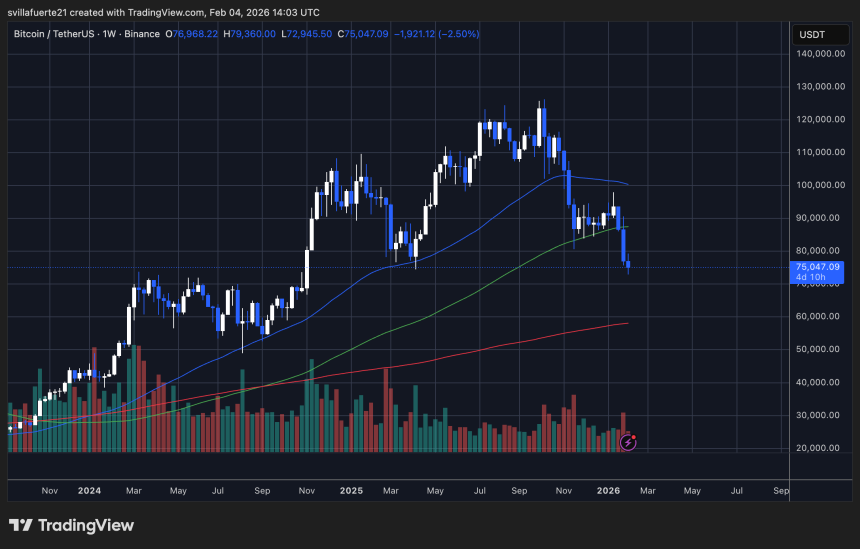
The recent breakdown followed a failed attempt to reclaim the $90,000–$95,000 zone. Which previously acted as support and has now flipped into resistance. This failure accelerated selling pressure and pushed the price toward the $74,000–$75,000 region. A level that coincides with prior consolidation and psychological support.
Related Reading
Despite the weakness, Bitcoin remains above the 200-week moving average (red), which continues to slope upward and currently sits well below the price. From a long-term perspective, this confirms that the macro uptrend remains intact. However, momentum clearly favors the downside in the medium term.
If $74,000 fails to hold, the chart indicates a deeper retracement toward the low $60,000s, where stronger historical demand resides. Conversely, any recovery attempt must first reclaim the 100-week moving average to shift the structure back toward neutrality. For now, the chart reflects a market under pressure, testing whether buyers are willing to defend this critical zone.
Featured image from ChatGPT, chart from TradingView.com
