



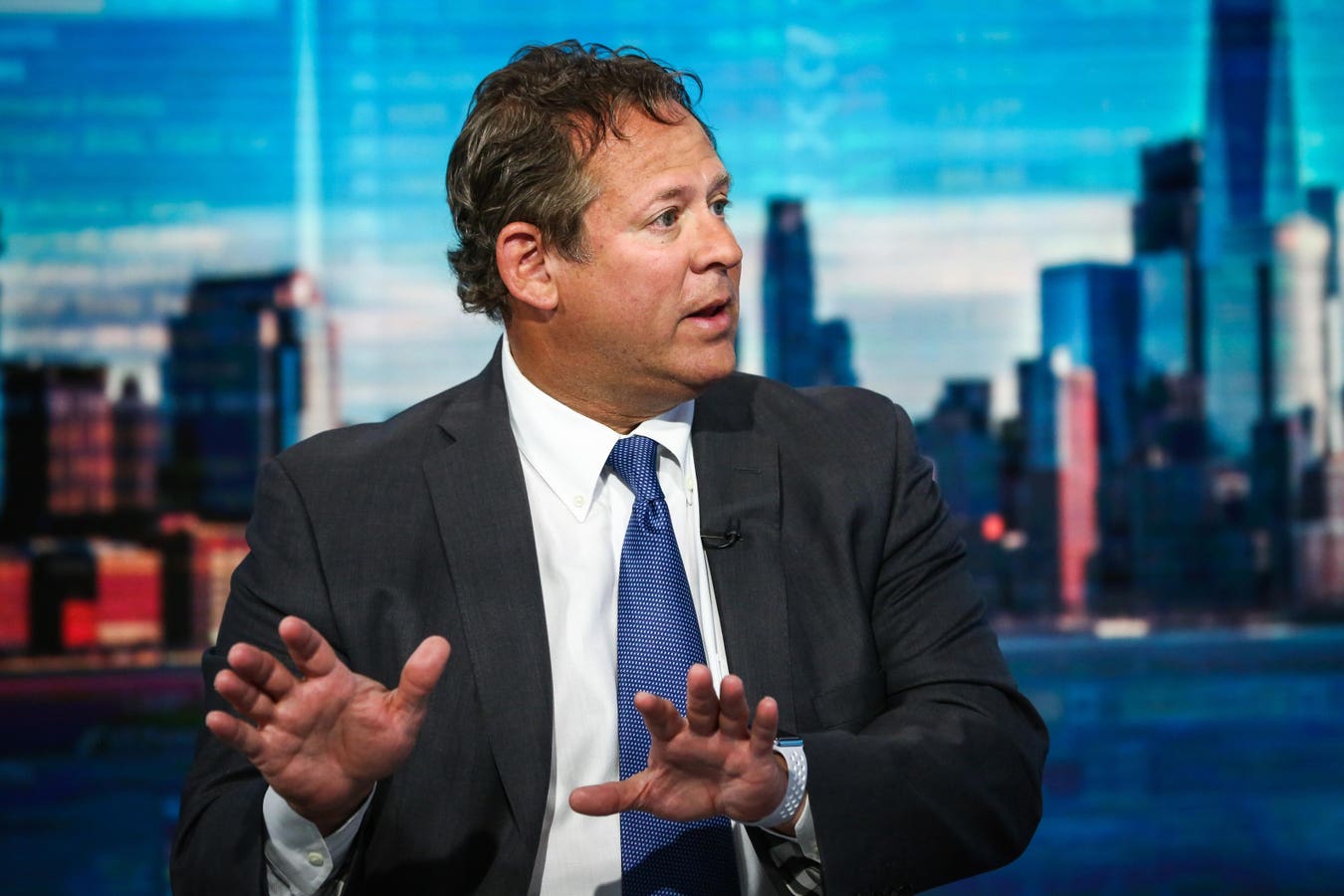

Rick Rieder, chief investment officer of fixed income for BlackRock Inc., speaks during a Bloomberg Television interview.. Photographer: Christopher Goodney/Bloomberg
© 2018 Bloomberg Finance LP
A new frontrunner has emerged to lead the Federal Reserve, and his selection could fundamentally shift how the central bank sets policy. Prediction market Polymarket now places BlackRock’s Rick Rieder firmly in the lead, a move that would put a market veteran, not an academic economist, in charge of steering interest rates at a moment when the Fed faces intense political pressure and heightened scrutiny. His rise isn’t just a personnel story; it’s a potential pivot point for monetary policy.
Reider’s odds of winning have surged from just 6% mid-month to more than 60% today, and Trump called him “very impressive” during an interview at the recent World Economic Forum in Davos. “I’d say we’re down to three, but we’re down to two. And I probably can tell you, we’re down to maybe one, in my mind,” Trump said at Davos. The nomination is expected by the end of January.
A Fed Pick Aligned With The White House’s Push For Lower Rates
The White House has made it very clear that it would like to see a more aggressive central bank approach to monetary policy. The Trump administration is leaning on the Fed to help lower interest rates and promote economic growth.
Of the four remaining candidates, Rieder is considered to have the most market experience, serving as the CIO of global fixed income at BlackRock while overseeing approximately $2.4 trillion in bond strategies. He would probably be considered the most market-savvy Fed chair in history.
While he has had no formal experience with the Fed or the government, he has served as vice chairman of the U.S. Treasury’s Borrowing Committee and as an active member of the New York Fed Investor Advisory Committee on Financial Markets. Through those relationships, he has spent enough time around the Fed to have a good understanding of its decision-making process and to have deep contacts within the institution. Compared to past chairs, Rieder would bring a practical, trading-floor perspective to the Fed rather than traditional academic theory
The Rieder View On Fed Policy
Rieder is regularly featured in the press, so we have a pretty clear idea of how he thinks about markets, and more importantly, how he might reshape the Fed. Past comments on monetary policy suggest that one of his first moves would be to lower rates to a level he considers less restrictive.
“I think the Fed’s got to get the rate down. The Fed’s got to get the rate down to 3%. I think that’s closer to equilibrium,” Rieder said in a Jan. 12 interview with CNBC. His desire to lower rates is something the White House surely applauds.
Rieder is also a proponent of a more creative use of the Fed’s balance sheet to achieve specific policy objectives. For example, he could propose a policy that to reinvest balance-sheet runoff or coupon proceeds into agency mortgage bonds rather than Treasuries to lower rates to help make home ownership more affordable to the average American.
Many economists view the lack of housing turnover as a factor limiting economic growth. “Three-quarters of the wealth in this country is in people’s homes. Without housing velocity, labor mobility suffers, construction employment stalls, and wealth formation for younger households breaks down,” Rieder said during a Dec. 12 episode of the Meb Faber Show podcast.
Reassuring Skeptics On Fed Independence
Markets will obviously scrutinize any nominee regarding their stance on Fed independence. On that front, Rieder fares well relative to other candidates. He sought to reassure potential skeptics in the CNBC interview noted above, saying, “Whoever is in the seat is going to make the right decisions for maximum employment and price stability.”
Rieder’s pro-growth mentality also makes him an appealing candidate to the Trump administration. He has argued that the U.S. needs a nominal GDP growth rate of 4.5% to 5% to maintain the ability to service debt obligations. This suggests that he might lean more heavily into the growth side of the Fed mandate rather than the inflation side.
Market Reaction To A Rieder-Led Fed
Some analysts believe the initial market reaction to his nomination would be positive. “A Rieder nomination would be the most market-friendly on first reaction, reflecting strong confidence in his understanding of financial markets and policy transmission,” according to a Poseidon Partners analysis published on Jan. 22.
Short-term Treasuries would likely rally as markets price in faster rate cuts toward 3%. Rate-sensitive equity sectors such as housing, REITs, utilities and small-cap stocks could benefit from lower debt costs, assuming long-term bond yields don’t react negatively. Long-duration risk assets, such as technology growth stocks, could also benefit from lower discount rates.
The Confirmation Fight: Where Rieder Could Face Resistance
The biggest obstacle for a Rieder nomination would likely be Senate confirmation. Democrats may scrutinize any potential conflicts of interest with BlackRock, the world’s largest asset manager, or harp on his lack of explicit government experience.
In addition, the qualities that make him appealing to markets could also pose risks for the Federal Reserve. A chair with strong trading-floor instincts may be more reactive to asset-price volatility, raising concerns that monetary policy could adjust more frequently than absolutely necessary. Also, his openness to using the Fed’s balance sheet to influence mortgage rates directly could blur the line between monetary and fiscal policy.
From a Republican perspective, Rieder should not have any issues in the confirmation process. His profile is viewed as less politically contentious than that of some other nominees, given that he has stated that Fed independence is critical, has deep market expertise and technical credibility, has no history of publicly attacking Fed policy, and is viewed as pragmatic rather than ideological.
If confirmed, Rick Rieder would bring a level of market expertise rarely seen at the Federal Reserve. Whether that expertise strengthens or complicates monetary policy will depend less on his market savvy than on his ability to preserve the Fed’s institutional discipline and independence at a time of heightened scrutiny.
