



Pakin Songmor | Moment | Getty Images
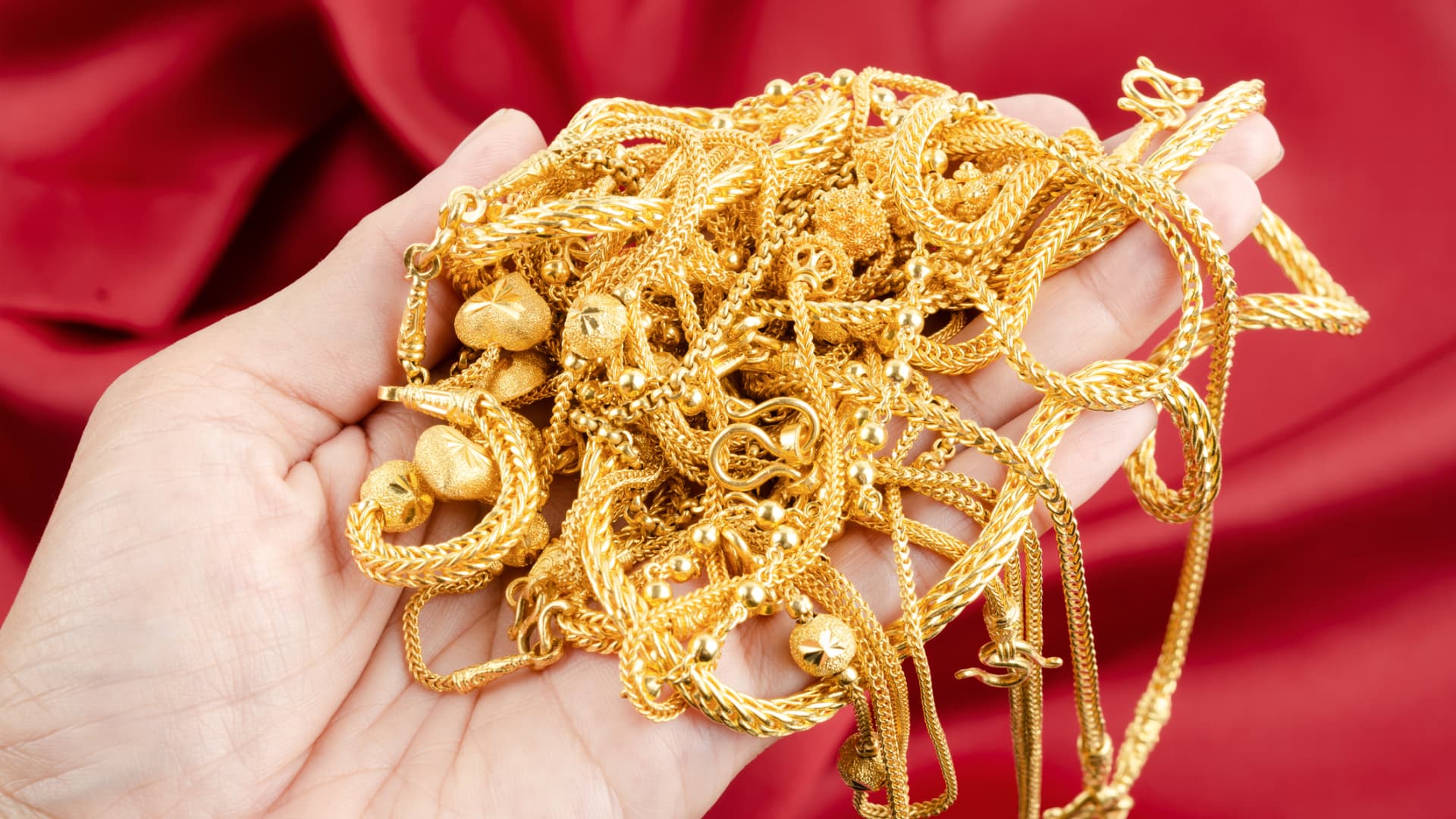
If you own jewelry made of gold or another precious metal, you should probably check your homeowners insurance to see if your coverage is sufficient.
The market price of gold has shot up over the last year, as have the prices paid for other precious metals like platinum and silver, both of which are also commonly used in jewelry. This means the value of your pieces could be higher than what your insurance would pay if they were stolen or destroyed in, say, a fire — especially if you have owned the jewelry for quite some time.
“A piece you bought or last appraised years ago could now cost significantly more to replace,” said Loretta Worters, spokesperson for the Insurance Information Institute.
Gold prices surge
The price paid for a troy ounce (31.1 grams) of gold is up about 58% over the last year to about $4,200 in Monday morning trading. Platinum and silver prices (per troy ounce) have also seen outsized jumps of 76% to about $1,651 and 84% to about $58, respectively, in the same period. Since 2000, the price of gold has increased roughly 1,400%. That compares to the Standard & Poor’s 500 index’s gain of about 382% over the same time.
Gold pieces accounted for the largest share — 54.9% — of the $366.8 billion global jewelry market last year, according to Grand View Research. Retail prices are generally higher than the intrinsic value of the metal in jewelry, although how high depends on the quality of the piece, as well as its actual gold content.
The commonly referred-to spot price is for pure gold (24 karat), which is soft and malleable. Jewelry makers combine gold with other metals — often silver, zinc or copper — to make the piece sturdier or give it a particular hue. For example, 14 karat gold jewelry is 58.3% gold, while 10 karat is 41.7% gold. The higher the karat, the greater the gold content — and in turn, the higher the intrinsic value.
However, that metal value differs from the replacement value of any particular piece — which is generally more closely related to the retail price — when it comes to insurance. Standard homeowners or rental insurance policies generally have low coverage for jewelry.
“Most homeowners and renters policies cover jewelry as personal property for common risks like theft or fire, but they typically apply special limits, often around $1,000 to $2,500 total, and don’t cover accidental loss or wear and tear,” said Sarah Cast, specialty lines vice president at Allstate.
“If someone owns higher-value pieces, especially with gold values climbing, it’s smart to check those limits and consider options to fill the gap,” Cast said.
Higher-value pieces should be ‘scheduled’
You may be able to add a rider to your existing policy that provides more coverage, or you could get a standalone policy. Either way, because some options impose per-piece limits, be sure you know the value of each piece of jewelry.
“Many insurers and advisors recommend reappraising jewelry every few years, especially when market conditions (like gold price surges) shift to ensure coverage stays adequate,” Worters of the Insurance Information Institute said.
If you have high-value items, you may want to “schedule” them — that is, create a detailed list that identifies each piece, including photos and an appraisal or sales receipt for each, along with the cost to replace them.
Coverage can range from a few thousand dollars to hundreds of thousands of dollars, depending on the items and the insurer, Worters said.
The deductible for these policies typically is no more than $500, she said. The premium is usually 1% to 3% of the insured value each year.
You also may notice broader coverage for perils: including mysterious disappearance, accidental loss and sometimes damage, according to Worters.
Some insurers offer riders or “valuable-articles” policies that automatically adjust for rising value under certain conditions, she said.
In the meantime, “take inventory with photos and appraisals and keep everything in a safe place,” Allstate’s Cast said. “Then review your policy details with your insurer and connect with an agent … to decide whether adding valuable item protection or buying a separate jewelry policy makes the most sense.”
